Work Zone Crash Liability in Massachusetts: Contractor, MassDOT, Bus, or Driver?
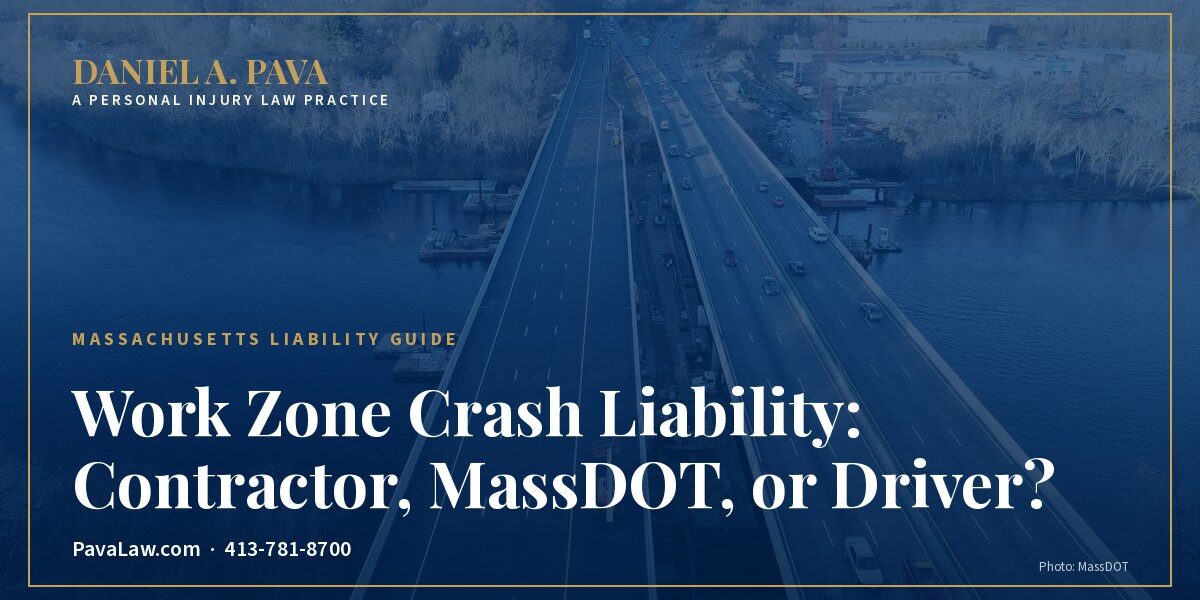
Hampden County is in the middle of the biggest wave of road construction it has seen in decades. The X in Springfield, Boston Road, Memorial Drive in Chicopee, I-391 into Holyoke, and Sumner Avenue are all active work zones at the same time, and several of them will stay that way until 2029 or 2030. That means thousands of drivers a day are moving through narrowed lanes, temporary signals, and shifting detours. When one of those setups contributes to a crash, the question of who pays gets complicated fast. This page explains how Attorney Daniel A. Pava approaches that question for drivers and passengers hurt in a Massachusetts work zone.
- Another driver: Still the most common at-fault party. Work zones don't excuse tailgating, speeding, or a late merge.
- The contractor: Liable if signs, cones, barriers, or lane markings were missing, misplaced, or confusing.
- MassDOT or the city: Possible, but claims against public agencies have strict deadlines and damage caps.
- A bus or truck: Transit buses and construction vehicles add a fourth defendant. Passengers have a claim no matter who caused it.
- More than one: Very often. Massachusetts lets you recover from every party whose negligence contributed.
Why Work Zones Change the Liability Picture
In an ordinary crash, fault comes down to the drivers. In a work zone, a third factor enters: the design and maintenance of the zone itself. Every construction project on a public road in Massachusetts operates under a traffic control plan that dictates where signs go, how far in advance a lane drop must be announced, how barrels are spaced, and how detours are marked. When that plan is followed, the zone is reasonably safe and a crash inside it is usually just a crash between drivers. When it is not followed, the zone becomes a cause, and the people responsible for it share the blame.
The practical difference is money. A driver's auto policy in Massachusetts may carry as little as $20,000 in bodily injury coverage. A contractor working a $27.5 million MassDOT project carries commercial liability insurance measured in the millions. If your injuries are serious and the zone contributed to the crash, identifying that second defendant is often the difference between a settlement that covers your medical bills and one that does not.
The Four Parties Who Can Be Liable
1. The Other Driver
Start here, because it is where most work zone cases still land. Massachusetts doubles the fine for speeding in a posted work zone, and for good reason: the crash patterns in construction areas are almost always driver behavior colliding with reduced margins. Rear-end hits at the back of slowed traffic. Late merges where two lanes become one. Sideswipes when a driver drifts across a shifted lane line. If the other driver was speeding, following too closely, on their phone, or forced a merge, they are liable regardless of the construction.
The work zone still matters to your case even here. It explains why a low-speed impact caused serious injury (nowhere to swerve, concrete barriers instead of a shoulder) and it undercuts the other driver's excuses.
2. The Contractor and Its Subcontractors
The general contractor on a MassDOT or municipal project is responsible for setting up and maintaining the work zone according to the approved traffic control plan and the state's traffic control standards. Common failures that create contractor liability:
- A lane-drop sign placed too close to the merge point, or missing entirely
- Barrels or cones knocked out of position and not reset
- Old lane markings left visible under new temporary ones, so drivers see two sets of lines
- A detour sign missing at a turn, sending drivers into oncoming traffic or a closed road
- Uneven pavement, a drop-off at a milled edge, or steel plates left unsecured
- Equipment or trucks entering the travel lane without a flagger or warning
- Work continuing outside the permitted hours, when drivers do not expect it
Many projects also use a separate traffic-control subcontractor for signage and flagging, and a separate paving or utility subcontractor for the physical work. Each carries its own insurance and each can be named. Sorting out who was responsible for what on the day of your crash is a large part of what we do in these cases.
3. MassDOT or the City
Public agencies can be liable for a work zone crash, but Massachusetts law makes these claims harder and less valuable than claims against private parties, which is why an experienced lawyer looks at them last rather than first.
MassDOT and state projects. Claims against the Commonwealth fall under the Massachusetts Tort Claims Act. You must formally present the claim in writing to the correct state official within two years of the injury, before you can file suit, and recoverable damages are capped at $100,000 per person. Miss the presentment deadline and the claim is gone, no matter how strong it was.
City and town roads. For a crash caused by a defect in a municipal road (a pothole, a missing sign, an unsafe condition the city created or failed to fix), the rules are even tighter: written notice to the city within 30 days, and recovery limited to $5,000. That cap makes a pure road-defect claim against Springfield, Chicopee, or Holyoke rarely worth pursuing on its own. It becomes useful only as one piece of a larger claim against a contractor or driver.
The lesson: if a public agency may be involved, call a lawyer early. The 30-day and two-year clocks start on the day of the crash, not the day you decide to make a claim.
4. A Bus, Transit Authority, or Commercial Vehicle
Work zones concentrate large vehicles: dump trucks, excavators moving between staging areas, and city and PVTA buses running their normal routes through narrowed lanes. When one of them is involved, the case gets a fourth defendant and a specific order of operations.
Attorney Pava is currently handling a work zone crash in which a transit bus struck a piece of construction equipment. The sequence in a case like that is to pursue the vehicle operator first, because the operator owes the highest duty to passengers and to everyone in the lane, and then the equipment owner and contractor if the excavator was positioned or moving where it should not have been. A regional transit authority is a public employer, so the same Tort Claims Act presentment deadline applies to the bus side of the claim, while the contractor side is an ordinary negligence claim with no cap.
If you were a passenger on a bus in a work zone crash, you have a claim regardless of which vehicle caused it. Bus passengers are almost never at fault, and PIP applies to you through the bus's coverage. Read more on what changes when a truck or commercial vehicle is involved.
Hurt in a Hampden County work zone?
The zone that caused your crash may look completely different next week. Call before the evidence changes. Attorney Pava reviews work zone cases free, and you owe nothing unless we recover for you.
Review My Work Zone CrashThe Evidence That Disappears First
Work zones are temporary by definition. On The X, the lane configuration can change between phases in a matter of days. On I-391, a ramp that was closed on Tuesday may reopen Thursday. Once the setup changes, proving what a driver actually saw becomes a fight between memories. Here is what to capture, in order of how fast it vanishes:
- The signs, cones, barrels, and lane lines, exactly as they were. Wide shots showing the approach to the crash point, then close-ups. Include anything missing, knocked over, or contradictory. Note the time.
- The date and the phase. Screenshot MassDOT's project alert email or the news notice for that week. Our X construction tracker and I-391 status log exist partly for this reason.
- Contractor identification. Company names on trucks, equipment, and the project sign at the entrance to the zone. A photo of a logo saves weeks of records requests later.
- Witnesses, including flaggers and police details. A police detail officer at a work zone saw the setup every day. Get a name.
- Everything on our standard list. What to collect at the scene still applies: the other driver's information, the police report number, your own injuries documented the same day.
If you were hurt and could not photograph anything, tell us anyway. Contractors keep daily logs and traffic control inspection records, and MassDOT keeps project diaries. Those can be obtained, but only if someone asks before they are archived.
What If I Was Partly at Fault?
Work zone crashes frequently involve some blame on every side: you were going a little fast, the other driver merged late, the lane-drop sign was too close. Massachusetts uses modified comparative negligence. You can recover as long as you were not more at fault than the parties you are claiming against, and your award is reduced by your percentage of fault. Having a contractor in the case often helps here, because spreading fault across three or four parties instead of two makes it far less likely that you end up over the line. Read more on what happens when an accident was partly your fault.
A Note on Who This Page Is For
This page covers drivers, passengers, cyclists, and pedestrians injured by a crash in or near a road construction zone. It does not cover construction workers injured on the job, which is a workers' compensation matter and not an area our office handles.
Active Work Zones We Are Tracking
Each of these pages carries a dated status log and the specific crash pattern for that project:
Route 20, West Springfield. MassDOT began milling and paving on Route 20 between Dewey Street and Lower Beverly Hills Road on October 8, with weekday lane closures from 6 a.m. to 5 p.m. expected to run for several weeks. Milled edges, shifted lane lines, and single-lane traffic on a corridor that feeds I-91 and the Memorial Bridge are exactly the conditions this page describes.
If you were hurt in or near this zone, photograph the signage, the lane markings, and any contractor name on trucks or the project sign before the setup changes. For crashes on the highway side of this corridor, see our I-91 West Springfield accident page.
Disclaimer: This page is general information about Massachusetts law and does not constitute legal advice. Deadlines, caps, and notice requirements are summarized and can change; the facts of your crash determine which rules apply. Contact our office for advice about your situation.
Just Been in a Crash? Start Here.
What you do in the next 24 hours can make or break a work zone case. These are the questions our clients ask most often:

Daniel A. Pava
Specializing in high-stakes highway collisions and commercial vehicle negligence, Attorney Daniel A. Pava provides focused legal representation for accident victims in Springfield and throughout Western Massachusetts.
View Professional Bio →See our recent settlements & case results Do I Have a Case? Free 60-second check
Let's Connect
Our Main Office
1380 Main Street Su.301
Springfield, MA 01103
Fax
857-366-9696
Get a Free Case Evaluation
We are here
Mon-Fri 9:00am - 5:00pm